
Behind the Myth
The Last Ptolemaic - Cleopatra

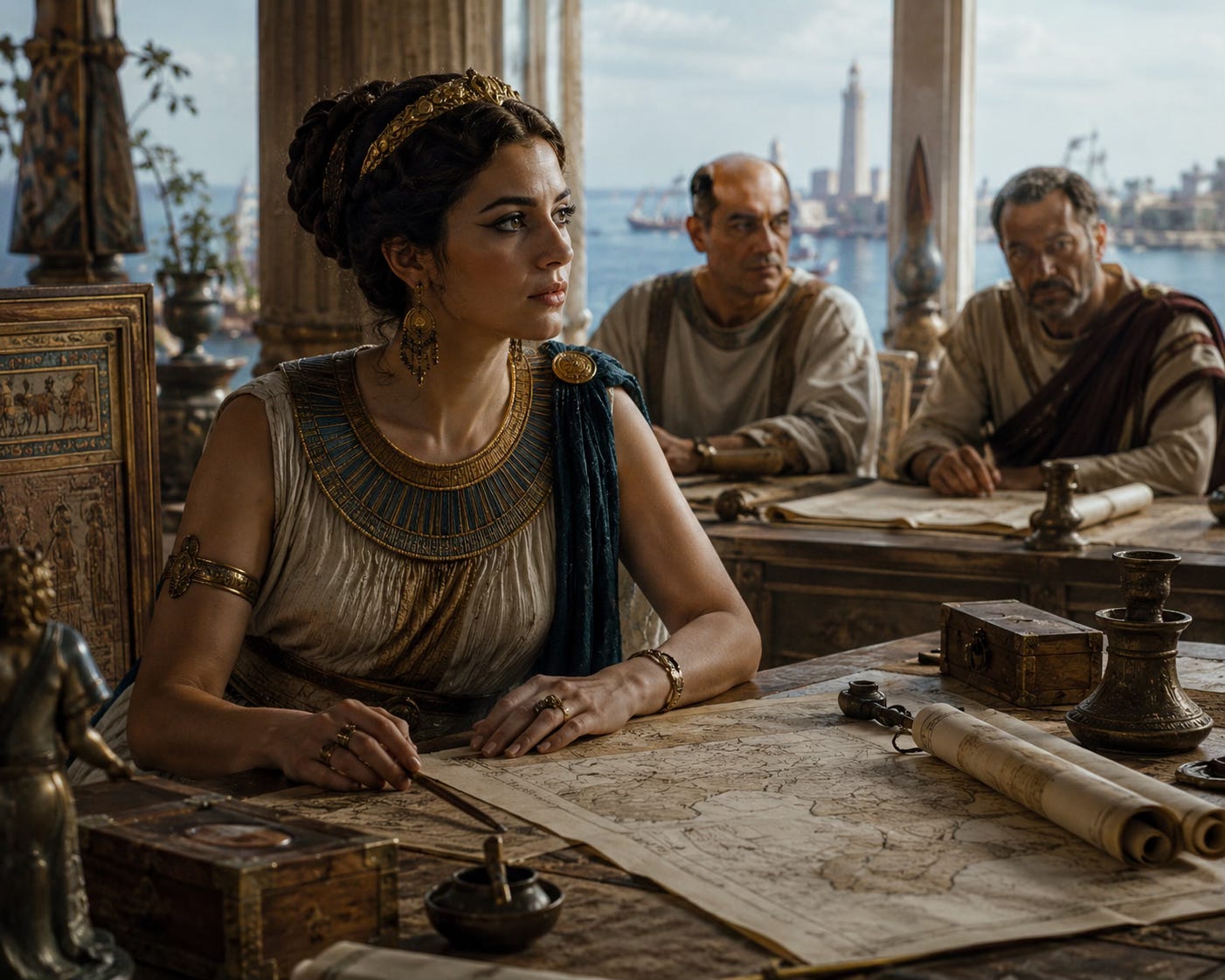
Cleopatra is rarely remembered alone.
Even when she appears by herself, other things arrive with her: silk, gold, perfume, a city already old when others were still becoming, and a way of being looked at that makes it difficult to tell where the woman ends and what has already been said about her begins.
In the telling, she does not need to speak. Others speak. They describe her, they remember her, they repeat what she did to men and almost never what she did to survive them. She appears already completed: beautiful, dangerous, impossible… the kind of woman who enters history through rooms rather than through doors, whose victories belong less to strategy than to proximity, whose power is always explained as a form of proximity to men rather than as a thing she built and held and defended across twenty-one years of rule.
She is remembered beside men. One arrives before, one arrives after, one loses, one dies. And she remains where she has always been placed, between them, becoming the explanation for what could not be allowed to belong entirely to themselves.
What the telling does not ask is how she ruled. It does not ask what she built, what she knew, what language she used when she wanted to be understood without a translator standing between herself and the person she needed to persuade. It does not ask what kind of political situation requires a sovereign to negotiate with an empire that has already decided your kingdom belongs to it. It asks instead what she wore, who loved her, how she entered a room, what she looked like. And so the woman begins to disappear, not through erasure but through replacement. She ruled a kingdom and was remembered as a body, and once that takes hold, nothing that follows arrives untouched by it.
This is what myth does when it is working correctly: it provides a legible form for something that would otherwise be difficult to absorb.
A woman who held sovereign power in the ancient world, who was a linguist and a political strategist and a theologian and a naval commander, who understood that spectacle was governance and used it accordingly, who chose her alliances with the precision of someone who had studied what happened to kingdoms that chose wrong; that woman is difficult. She requires the reader to revise assumptions about where power lives and who is permitted to hold it.
The myth resolves this difficulty by relocating her power entirely to her body and her effect on men, which is a form of power the culture already has a category for, already knows how to contain.
Behind her stood Alexandria. Not the Alexandria of postcards and ruins, but a living capital of ships, warehouses, diplomats, priests, scholars, tax collectors, grain fleets, temples, and laws; a city that connected Egypt to the wider Mediterranean and a kingdom whose administration had survived centuries of succession crises, foreign pressures, and dynastic conflict. None of this enters the myth easily. A kingdom is difficult to carry. A beautiful woman is not.
What remains after that relocation is a figure rather than a person. Vivid, yes. Unforgettable, yes. But no longer threatening in the way a sovereign is threatening, no longer requiring the kind of reckoning that competence demands.
This is what we are actually looking at when we look at Cleopatra as she has been handed to us: not a woman but a function. The function of explaining male defeat without implicating male judgment. The function of making power erotic rather than structural. The function of allowing a kingdom’s fall to read as a love story rather than a geopolitical inevitability that had been building for a century before she was born.
The woman inside that function is the more interesting subject. And she is harder to reach than she appears, not because the record is sparse, but because every layer of the record has already decided what she was… before the reading begins.
Cleopatra is one of the most famous women in history.
Most people have never met her.
