

Human 0%. - Yes this deserves red flag. But not for what you think.
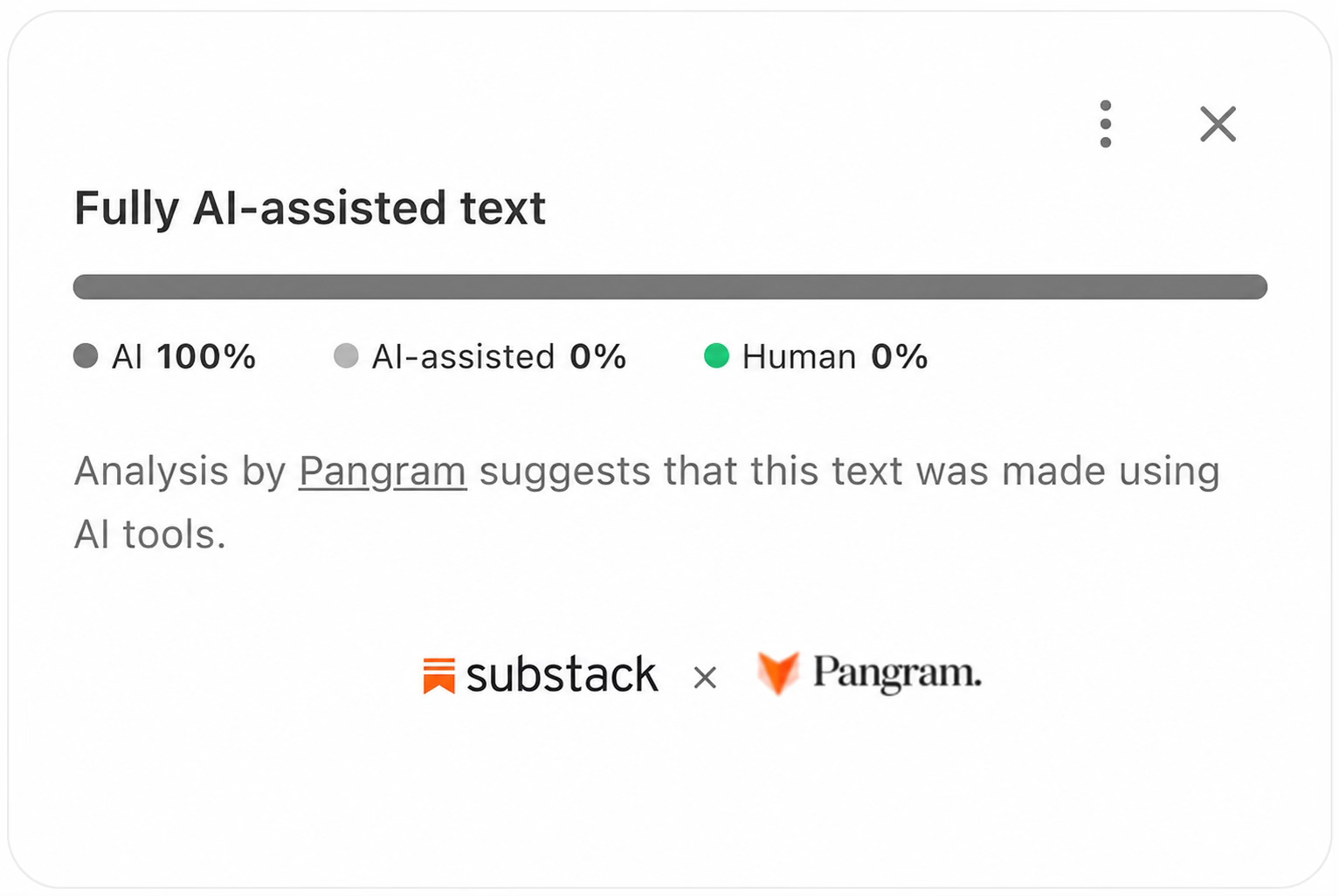
Those are the words upon the screen. Not perhaps assisted; not bearing certain resemblances; not even the modest confession that a statistical instrument had encountered a pattern for which it had been trained to search.
The judgment was entire. AI 100%. Human 0%.
The text belonged to a novelist whom I had watched publish the same work, chapter by chapter, for as long as I can now remember.
Another writer, whose prose I know and esteem, had reached the twenty-third chapter of her own serial tale when the same judgment appeared.
Their readers hadn’t met these works as finished objects dropped suddenly from an unknown hand. They had seen characters return, images gather meaning, and the peculiar habits of a mind preserve themselves across time; in one case, they had even grown familiar with the writer’s recurring errors and the letters which exchanged their places.
None of these things, taken singly, can prove that no instrument was ever used in the making of a sentence; yet together they form something of which the classifier is wholly destitute: a history of the hand at work.
The machine had witnessed none of it. It had seen no first conception, no abandoned page, no name altered after ten chapters because the former name had begun to sound strange, no sentence carried through a sleepless night, and rejected in the morning.
It knew neither the writer nor the work; it possessed no memory of the road by which the latest chapter had been reached. Nevertheless, having received a portion of text, it spoke with a certainty greater than any honest witness would have dared to claim.
The obscenity lay not only in the possibility that the machine was wrong. It lay in the spectacle of an instrument which had witnessed nothing being permitted to declare that the human contribution was nothing.
On 21 July 2026, Substack placed this power behind the three dots of its Reader.
A post, a note, a reply, or a comment of sufficient length, may now be submitted by any reader to an artificial-intelligence classifier supplied by Pangram.
Within moments there appears an estimate of what proportion is said to be human, assisted, or artificial. The result is not affixed publicly by default, which will doubtless be offered as evidence of restraint. Yet we inhabit an age in which a private result becomes a public accusation by means of a screenshot, and in which the accusation commonly travels farther than any correction that may follow it.
A tribunal need not possess a courtroom when every pocket contains the means of publication.
Substack calls this “transparency”. This word deserves examination, for transparency properly concerns that which can be made visible.
The act of writing is not visible to Pangram. The instrument did not observe the process whose origin it is invited to pronounce upon; it received only the finished prose. What it can discern are patterns, affinities, recurrences, and distances within a learned field.
Pangram itself explains its classifier by means of a map upon which human and machine writing occupy distinguishable regions. Faced with a new text, the model asks, in substance, where upon that map the writing appears to belong.
That may be a remarkable feat of classification. It is not an act of witness.
There is a difference, and upon that difference the whole moral question turns, between asking What does this resemble? and declaring Who made this?
Resemblance belongs to the text; provenance belongs to an event. The former may be estimated from patterns in language. The latter includes a history which the language alone cannot fully disclose: dictation, revision, collaboration, translation, memory, influence, editorial alteration, and the innumerable degrees by which one mind may employ or resist an instrument, without surrendering authorship to it.
A statistical model may be admirably skilled at recognising the traces left by the customary manners of present language models, while remaining incapable to see the actual passage by which a particular sentence entered the world.
Pangram does not conceal that it is a statistical model; indeed, it publishes accounts of its training, its internal measurements, and its claimed rarity of false positives. It would therefore be foolish to oppose the present arrangement by pretending that all detection is mere divination, or that no regular distinction can ever be discovered between large bodies of human, and machine-produced prose.
A tool may prove useful in the study of populations and yet become unfair when its estimate is applied as a verdict against a person. The census and the trial are not the same proceeding; a method fitted to one does not acquire moral fitness for the other merely because its arithmetic is sound.
Nor does the instrument cease to fail because its makers have laboured earnestly to reduce error. Pangram acknowledges that it performs less well upon such forms as poetry and recipes, and says that its best conditions include substantial passages composed in complete sentences.
Substack has nevertheless carried the classifier into notes, replies, and comments, those hurried and volatile provinces in which context is scant, form is irregular, and accusation is swift.
Poetry, moreover, is not some negligible eccentricity at the margin of letters. It is among the oldest means by which human beings have compelled language to bear what ordinary statement cannot contain. Measure, recurrence, compression, inversion, and the accord of sound with silence are not defects which poetry must surrender in order to satisfy a machine’s expectation of humanity.
The contradictions are not merely hypothetical. Freddie deBoer has publicly described how a passage of roughly three hundred words from an essay of his was judged fully artificial, while the essay of approximately five thousand words containing that very passage was judged fully human; when the condemned passage was divided again, parts of it returned to the human side. Whatever explanation may be given concerning context windows, thresholds, or the proper interpretation of the score, the ordinary reader is not shown a lecture upon those subtleties. The ordinary reader is shown: AI 100%. Human 0%.
Yet my objection does not stand or fall with the production of enough embarrassing mistakes. If every present false positive were corrected tomorrow, the question of legitimacy would remain.
Accuracy answers how often an instrument reaches the expected classification under specified conditions. It does not answer who ought to be permitted to use that classification against whom, what social consequence should follow, what evidence may rebut it, or who shall bear responsibility when a numerical estimate is converted into a public charge.
An instrument may be accurate and still be indecent in its purpose, its distribution, or the authority carelessly bestowed upon it. Its errors make it reckless; belief in its infallibility would make it tyrannical.
I wish to be equally plain upon another matter. I detest what has come to be called AI slop. I detest the industrial manufacture of empty language; the counterfeit of thought produced without the labour of thinking; the simulation of intimacy for the purpose of extracting attention, confidence, and money from readers; the daily deluge by which one person, having almost nothing to say, may occupy more space than ten serious writers possess the strength or time to fill.
There is fraud in presenting such production as the solitary work of a mind, and there is contempt for the reader in asking payment, praise, or trust upon a false account of how the work was made.
But the vileness of the accused has always been the easiest argument by which an instrument of policing is made to appear virtuous.
Freedom which extends only to speech we admire, is no freedom at all; justice which requires us first to love the defendant, is only favour wearing a noble name. One may despise the counterfeit and still refuse the inquisition. Indeed, those who have learned to fear the power of artificial intelligence, should be the last to confer upon another artificial system the authority to judge, with the appearance of certainty, whether a human being may be believed concerning the origin of their own words.
My country supplies me with a memory against which I cannot write as though history had never occurred.
Under the Estado Novo, prior censorship placed an authority between the writer and the public. Journalists, authors, dramatists, and artists knew the blue pencil which struck out what might not be permitted to pass. They learned not only what the censor would remove, but how to anticipate removal; language bent beneath an inspection which had not yet taken place.
On 25 April 1974, Portugal put an end to that regime and abolished prior censorship.
Pangram is not the Estado Novo. It does not seize a press, suppress publication, or imprison a writer; to claim an equivalence would diminish the historical reality of those who were silenced, persecuted, and confined. But the duty of memory is not to forbid every comparison, until the latest instrument has become identical to the oldest oppression.
Memory teaches us to recognise habits before they have acquired their final institution: the insertion of an examining authority between writer and reader; the conversion of suspicion into procedure; the reversal by which the accused must prove a negative; the gradual education of the writer in those forms of self-erasure which may avert scrutiny.
The old censor altered the text. The new arrangement alters the conditions under which the writers may be believed; and, in time, the writers begins to alter themselves.
For once authors are taught that polish, balance, recurrence, a certain vocabulary, or the visible architecture of an argument may cause their work to resemble a machine, they will be tempted to defend themselves within the sentence. They will break what ought to remain whole, retain what ought to be corrected, introduce disorder where order was earned, and surrender words which belong to them because an algorithm has made those words unsafe.
Human beings will learn to counterfeit carelessness in order to pass as human.
The degradation could scarcely be more complete: after machines were trained upon the inheritance of human language, human writers will be required to mutilate that inheritance lest they resemble the machines trained upon it.
This is censorship’s inward victory, though no sentence has been formally forbidden. The blue pencil need no longer descend upon the page when the writer has been taught to hold it against herself.
There remains also the punishment which a platform never needs to administer directly.
Substack has not announced a prison, a ban, or even an automatic mark upon the public page. It has done something more congenial to the manners of a social platform: it has distributed the investigation and left the crowd to devise the sentence. Within hours of the feature’s appearance, some readers were already rejoicing that Substack would become free of slop; objections to the detector were met with insinuations that only the guilty would object; named writers were subjected to public judgments in which a purported classification passed almost at once into a judgment of character, honesty, and literary worth.
The detector supplies not proof, but the appearance of proof; and appearance is often sufficient for punishment, where attention moves rapidly and malice need no answer for itself.
A reader presses a button, obtains a percentage, captures the screen, and presents the image as a receipt. The author must then produce drafts, notes, revision histories, witnesses, habits, and private records in order to contest a machine which was required to produce none of these things before accusing her.
The charge costs a moment; the defence may consume days; and the vindication, if it comes, will seldom travel so far as the scandal.
For writers whose livelihood depends upon the confidence of their readers, this is not an injury confined to sentiment. It may mean cancelled paid subscriptions, withdrawn recommendations, lost commissions, abandoned collaborations, or opportunities which vanish without the courtesy of explanation.
A writer may remain formally free to publish while being economically punished for having published. No officer need order their silence. It is enough that continued speech should become too costly, or that association with their name should be made to appear unsafe.
Thus the platform avoids the odium of censorship, while preserving its effects in dispersed form.
The machine issues the estimate; the reader performs the accusation; the crowd supplies the penalty; and Substack, having furnished the instrument and the occasion, may continue to speak of trust.
This is authority without the dignity of responsibility.
The author is permitted to disable detection upon an individual post or Note, whereupon readers are told that detection is unavailable.
The arrangement is almost exquisitely circular. If the author leaves the instrument active, they consent to a tribunal whose competence they may reasonably dispute.
If they disable it, the absence of the verdict may itself be offered as evidence that they feared the result.
A right of refusal which is displayed as a suspicious absence is not freedom from the accusation; it is another form in which the accusation may be made.
I shall nevertheless refuse it. I shall disable Pangram upon my work wherever Substack permits me to do so, and I shall do this openly, not because I fear what the classifier may say, but because I reject its jurisdiction.
My writing is answerable to criticism. Readers may find it beautiful or tedious, lucid or obscure, profound or mistaken; whatever. They may challenge my claims, expose my errors, reject my conclusions, or leave me altogether.
What they may not demand is that I submit my humanity to a machine as the price of being read in good faith.
Substack built much of its reputation upon the promise of a direct relation between writers and readers. It has now inserted an artificial classifier between them and called the intrusion transparency.
If the platform wishes to contend against industrial slop, let it contend against spam, automated volume, impersonation, hatred, deceptive commercial practice, and the manipulation of discovery by those who can manufacture a hundred empty publications in the time required to write one honest essay.
Let it enforce disclosures where disclosures are materially required. Let it design incentives which do not reward the flood. But let it not flatter the reader with a constable’s badge, convert resemblance into provenance, and leave the writer to endure the consequence.
The twenty-fifth of April did not abolish the blue pencil so that, fifty-two years later, I might welcome its digital imitation behind three dots.
Again, the instruments are not equivalent, and I shall not dishonour history by pretending that they are.
Neither shall I dishonour history by learning nothing from it. The forms of power alter; the appetite to inspect, classify, suspect, and silence commonly returns wearing the costume of whatever virtue the age most readily applauds.
Do not call this protection of human writing.
Do not call it care for writers.
A machine which has witnessed nothing has been invited to declare Human 0%, and human beings have been invited to punish one another upon its word.
This platform has become crowded with false intimacy, manufactured victimhood, predatory courses, unqualified healers, harassment, hate campaigns, coordinated pile-ons, and every variety of snake oil that can be poured into the language of love, healing, and community.
None of these can be identified by a percentage. They require a human being to read, to investigate, and to distinguish criticism from persecution, testimony from performance, consolation from exploitation, and persuasion from fraud.
Reader money is finite. Every subscription obtained through manufactured intimacy, false vulnerability, or promises of healing, removes money from the same limited economy in which serious writers are trying to survive.
The platform does not merely host both kinds of work. It rewards the people most skilled at converting loneliness into recurring revenue, then congratulates itself for supporting culture. Now it proposes to inspect how a sentence was produced while refusing to inspect how the customer was produced.
But this require rules, evidence, appeals, and the institutional courage to act against people who may also be profitable. Instead, Substack selected the only problem that could be outsourced to a classifier.
It chose what could be scored, not the problems that required courage.
Automated suspicion is cheaper than human responsibility.
Have you no shame? Substack?

Excellent article. I got into this discussion recently and remarked how I'd put Sylvia Plath's poem Lady Lazarus into one of those 99.9% accurate AI checkers (of course, I did this to prove a point). The AI checker indicated that Plath's poem was 85% AI written. Well, there you have it. Plath was using AI technology before it was ever a thing. I definitely fear the type of witch hunt this type of technology can produce. Btw, if you get a chance, look up Samuel Hurley's poem, AI vs the Poet. It's a brilliant read.
Your distinction between resemblance and provenance feels decisive.
A detector may identify patterns in finished language. It cannot witness the history of the work: the original experience, the questions pursued, the ideas rejected, the argument with the page, or the judgment that finally says, “Yes, this is what I mean.”
I write extensively with AI. It participates in my thinking and often in the language itself. But “Human 0%” would still be an absurd description of the work, because the human contribution is not merely the percentage of untouched sentences. It is the consciousness deciding what matters, recognizing what is false, and accepting responsibility for what is published.
Nor is AI a fully formed author entering the process unchanged. The interaction shapes what it produces. My questions, preferences, corrections, disagreements, and the history of the conversation all help create the particular voice that appears on the page. The finished language is not simply human or machine. It is the residue of a relationship and a process the detector never witnessed.
What concerns me most is what this measurement will teach writers to do. Once certain rhythms, structures, or degrees of polish trigger suspicion, human writers will begin optimizing for the detector rather than for the work. They may preserve awkwardness to prove their humanity, while people manufacturing empty content learn how to evade the score.
Then the metric will not merely misread writing. It will begin shaping it.