

Objects That Forgot Their Meaning
Five remnants from civilizations that vanished interpretively before they vanished physically

There are objects that survive the death of the worlds that once explained them, and these are among the most unsettling things human beings ever leave behind, because they confront us not simply with loss, but with a far more disturbing possibility: that meaning itself is fragile, temporary, historically dependent, and capable of collapsing long before matter does.
A ruined city still announces itself clearly. Walls remain walls. Roads continue resembling roads. Even destruction preserves intention to some degree. But certain objects endure in a stranger condition altogether, suspended somewhere between recognition and incomprehension, still visibly important yet severed from the systems that once made their importance legible. They arrive to us stripped of atmosphere. Detached from ritual. Removed from gesture, fear, cosmology, repetition, and belief. What survives is the shell of significance without the living structure that once animated it.
Museums attempt to stabilize this instability almost immediately. Labels appear beside the glass with reassuring formulations: ceremonial object, funerary artifact, ritual instrument, possible religious use. Modernity dislikes prolonged uncertainty and prefers even fragile explanation over the intolerable experience of standing before something whose purpose can no longer be fully reconstructed. We catalogue because classification creates the illusion that the object has been recovered intellectually, even when what survives is only its exterior.
But some objects resist this process with extraordinary force.
Not because they are mysterious in the theatrical sense, but because they expose how deeply human understanding depends on invisible collective agreements that can disappear almost completely while the material world remains behind. Entire civilizations once moved through symbolic systems that felt as immediate and obvious to them as language feels to us now, and yet centuries later their objects persist in a condition resembling silence, as though they continue speaking from inside a grammar humanity no longer remembers how to hear.
What disappears first is rarely the object itself.
What disappears first is the world capable of reading it.
The Externsteine Relief
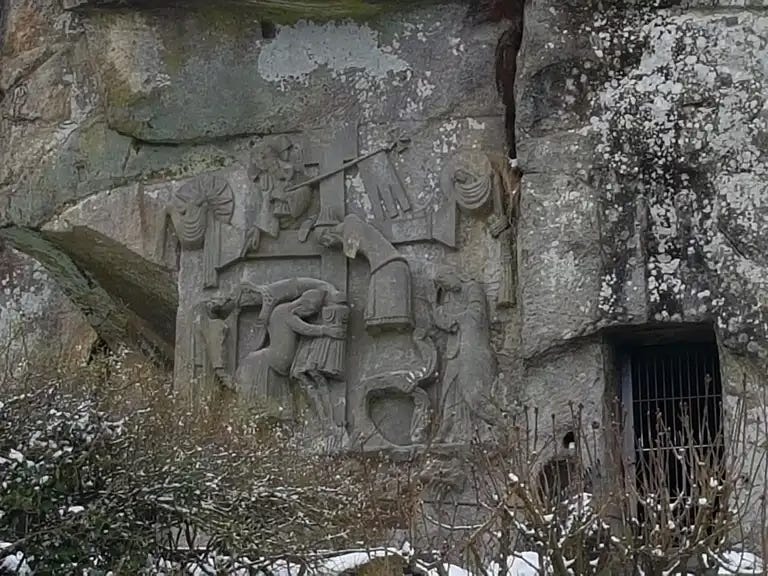
Carved directly into towering stone formations, the relief appears suspended between pagan residue and Christian transformation in a way that scholars still argue over intensely. It depicts a descent from the cross, yet beneath the central scene stands a bent tree-like form that may represent a shattered sacred pillar, possibly linked to the Irminsul of pre-Christian Saxon belief.
And that uncertainty changes everything.
Because the object no longer belongs clearly to either world.
It may preserve the visual memory of one cosmology being forced beneath another while both remain partially visible inside the same stone. Christianity is present, certainly, but something older seems to remain trapped beneath the composition like an unresolved geological layer of meaning.
What survives is not merely an image but evidence of symbolic collision.
The relief feels unstable because its interpretive center fractured historically. Was it triumph? Absorption? Deliberate overwriting? Preservation disguised as conversion? No consensus fully settles the matter because the cultural transition itself was incomplete, violent, and psychologically layered.
And this is precisely what gives the object weight.
It survived after the people capable of reading all its symbolic tensions disappeared.
Modern observers still perceive significance immediately, yet no longer possess the internal worldview necessary to stand where its creators stood. The stone continues carrying multiple realities simultaneously, but the civilization that understood how those realities coexisted is gone.
The Kudurru Stones
Modern societies separate categories aggressively because compartmentalization produces administrative clarity. Law belongs to institutions. Religion belongs to personal faith or ceremonial space. Astronomy belongs to science. Territory belongs to governance. Symbolism belongs to culture. The contemporary mind instinctively distributes meaning across specialized domains.
Ancient civilizations often did the opposite.
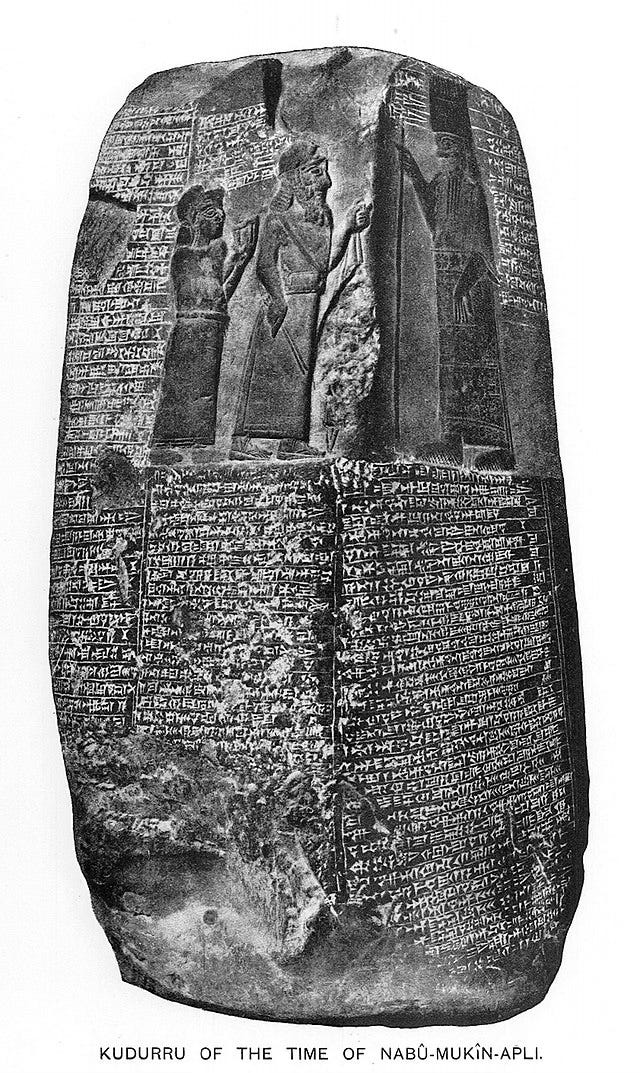
The Kudurru stones emerged from a world in which these distinctions had not yet fractured into isolated systems, and because of this they appear almost overloaded with significance when viewed through modern eyes. These Babylonian boundary stones recorded agreements concerning land ownership and territorial authority, yet they simultaneously invoked divine powers, celestial symbols, curses, sacred legitimacy, dynastic continuity, and metaphysical protection in ways that are difficult to translate cleanly into contemporary categories.
To violate such a boundary was not merely illegal in the procedural sense modern people understand.
It constituted a disturbance within a cosmic order that involved gods themselves.
The carvings covering the stones still retain traces of this density. Symbols accumulate with an urgency suggesting that the object functioned not merely as documentation but as active reinforcement of reality. Political order, divine authority, astronomy, fear, and sacred legitimacy converged physically upon the same surface because they were not understood as separate dimensions of existence.
Now these stones stand motionless behind museum glass while observers admire texture, craftsmanship, or historical age. Yet what has vanished is not merely the original legal system but the entire metaphysical structure in which law itself required celestial participation in order to possess ultimate authority.
The stones survive materially.
The universe that once enforced them has disappeared.
The Derveni Krater
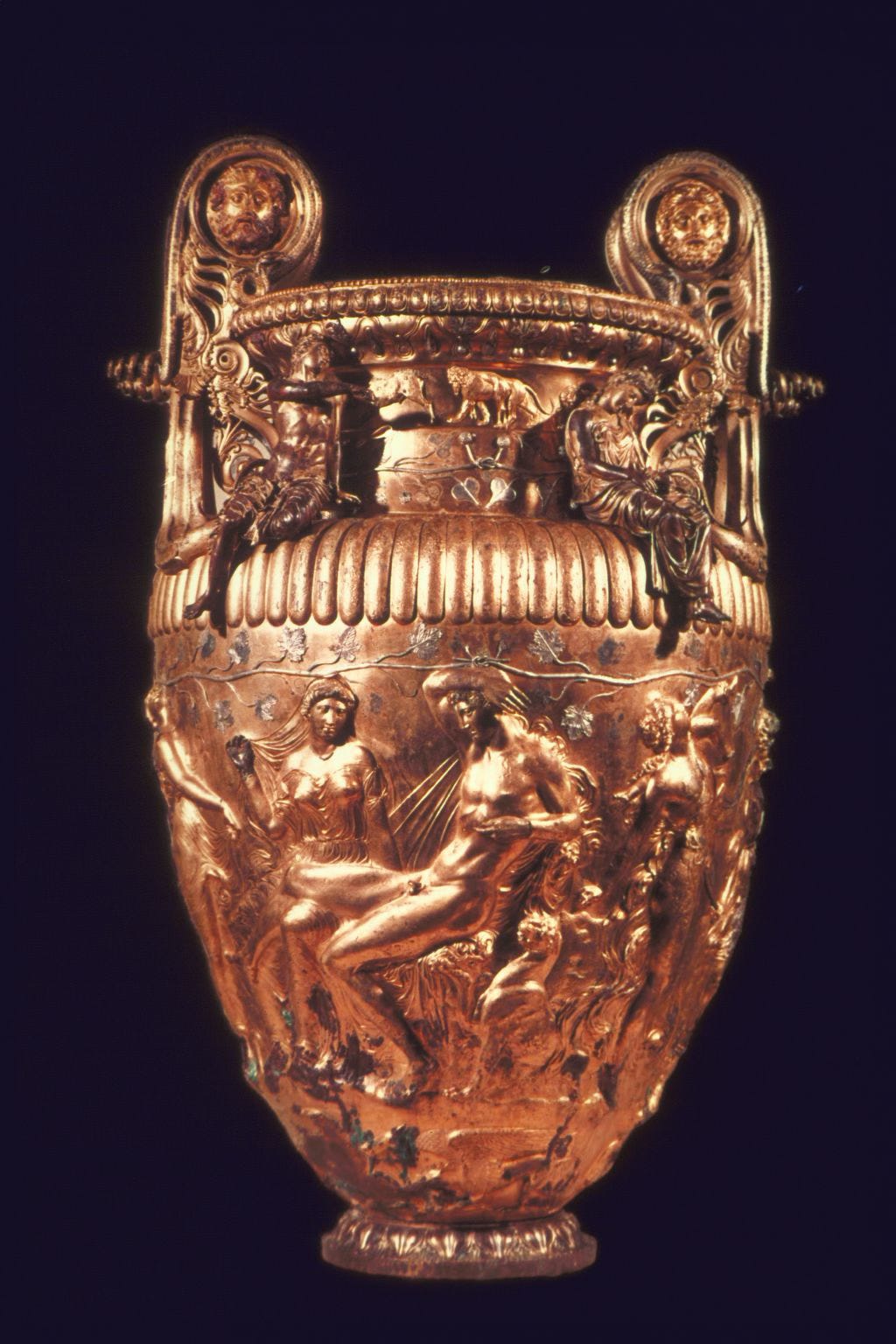
The Derveni Krater survives in a condition that feels almost cruelly intact. Unlike many ancient remnants fractured into incomprehensibility, this enormous bronze vessel still carries extraordinary detail across its surface: gods, movements, ornaments, mythological scenes, delicate expressions frozen into metal with astonishing precision. It appears communicative. It appears readable. And yet the deeper one looks, the more obvious it becomes that what has vanished is not the object, but the symbolic atmosphere that once animated every inch of it.
Officially, it functioned as a funerary mixing vessel, likely connected to elite burial ritual in ancient Macedonia. But that description explains almost nothing.
Because objects like this did not merely “serve a purpose.” They existed inside dense networks of metaphysical association where wine, death, ecstasy, transformation, status, divine contact, and ritual transition overlapped continuously. Dionysian imagery covering the vessel was not decorative in the modern sense. It participated in an understanding of existence where intoxication itself could function as passage between states of being.
And that is the world that disappeared.
Modern viewers still recognize technical mastery immediately because craftsmanship survives visually with remarkable strength. But the emotional and spiritual literacy once required to experience the vessel fully has collapsed almost entirely. We see mythology where its makers likely perceived active symbolic force. We see artistry where they may have experienced cosmological participation.
The Krater therefore survives in a strange condition of partial legibility.
Too intact to become abstract.
Too culturally distant to become fully understandable again.
It remains suspended between revelation and silence, still radiating importance while the civilization that knew precisely why it mattered has long since vanished.
The Sator Square (Pompeii)
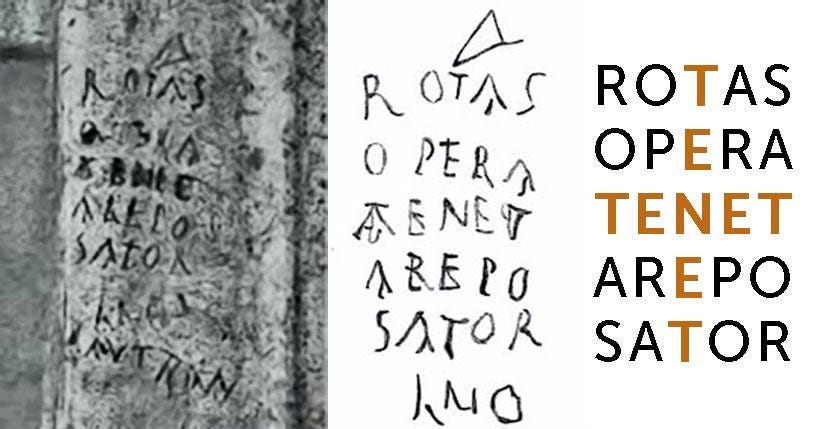
The structure appears deceptively simple until one remains with it long enough for its persistence to become unsettling.
The words form a perfect palindrome capable of being read horizontally and vertically while preserving arrangement and symmetry, and examples of the square have appeared across the Roman world in homes, military sites, ruins, and early Christian locations. Yet despite centuries of analysis, no consensus exists concerning its precise meaning or function. Protective charm, coded theology, magical formula, linguistic game, ritual invocation, symbolic diagram: interpretation proliferates without resolution.
Perhaps what makes the square so haunting is not merely uncertainty, but the realization that form itself can outlive explanation almost indefinitely.
Human beings preserve patterns with astonishing fidelity even after forgetting why those patterns mattered. Gestures survive religions. Rituals survive belief. Symbols circulate long after the emotional or metaphysical systems that generated them collapse entirely. Repetition creates continuity powerful enough to endure beyond understanding.
The Sator Square feels strangely contemporary because modern societies produce similar fragments constantly: symbols detached from origin yet endlessly reproduced, phrases repeated without historical memory, forms circulating independently from the worlds that once gave them depth.
What survives here is not meaning in the stable sense.
What survives is structure refusing extinction.
And perhaps that refusal reveals something profoundly human: our tendency to preserve shape long after comprehension begins dissolving beneath it.
The Nuragic Bronze Boat Models
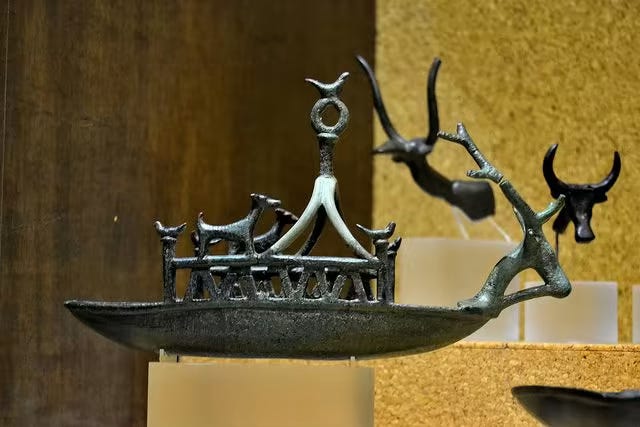
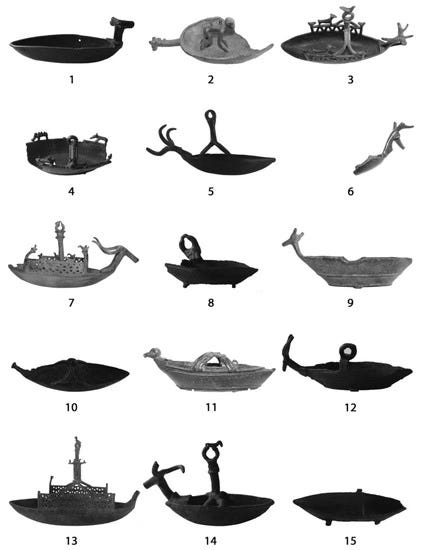
These small bronze vessels possess a peculiar emotional weight difficult to explain proportionally because nothing about their scale prepares the viewer for the density they seem to carry. Delicately crafted by the Nuragic civilization of Sardinia thousands of years ago, they appear simultaneously ceremonial and intimate, too deliberate to be decorative alone and too symbolically charged to feel merely practical.
But certainty fails quickly around them.
Were they funerary offerings intended to accompany the dead through symbolic passage?
Representations of trade and maritime power?
Miniature sacred vessels connected to mythological cosmologies now almost entirely lost?
Objects used in ritual exchange between human communities and divine forces?
No definitive interpretive structure survives intact enough to settle these questions completely.
And perhaps this uncertainty reveals something essential about the fate awaiting many civilizations eventually. The problem is not only that information disappears. Far more devastatingly, emotional proportion disappears alongside it. Future societies inherit objects without inheriting the instinctive understanding of what mattered enough for entire communities to shape ritual life around such forms.
Reverence erodes first internally before it vanishes historically.
The boats remain behind like compressed fragments of an emotional architecture humanity can still sense faintly without fully entering again. One perceives immediately that these objects once belonged to systems larger than ornamentation, yet sensation alone cannot resurrect a world.
And so the vessels remain permanently suspended at the edge of interpretation, still carrying traces of sacred movement while no longer fully reaching shore.
Perhaps this is why such objects disturb us more deeply than complete destruction.
Total ruin clarifies absence. But these remnants continue transmitting partial signals from civilizations no longer capable of answering for themselves. Enough survives to make the scale of disappearance visible. Enough remains intact to expose how much human meaning depends upon fragile collective frameworks that history can erase with astonishing thoroughness.
And beneath all archaeology lies an uncomfortable recognition modernity rarely enjoys contemplating: our own civilization is already manufacturing future incomprehensible objects.
Centuries from now, fragments of our world may survive detached from the technological, emotional, political, and symbolic systems that currently make them appear self-evident. Devices may persist without the networks that animated them. Symbols may remain visible after the ideologies that produced them have collapsed. Ritual gestures may continue circulating after the structures that once justified them disappear entirely.
Someone in another age may stand before the remnants of our civilization feeling the same bewilderment we experience now.
Not understanding what kind of people built such things.
Not understanding what invisible assumptions once made them meaningful.
Not understanding us at all.
What stayed with me most is the idea that meaning often disappears before the object itself does. Not destruction, but interpretive silence. These artifacts feel unsettling precisely because they still radiate importance while the world that once knew how to read them has vanished. “What disappears first is the world capable of reading it” carries something far beyond archaeology. It feels true of cultures, symbols, even people.
Thanks Sara, I always enjoy this series. Fondly, Michael