
On Easter
The Pattern That Will Not Die

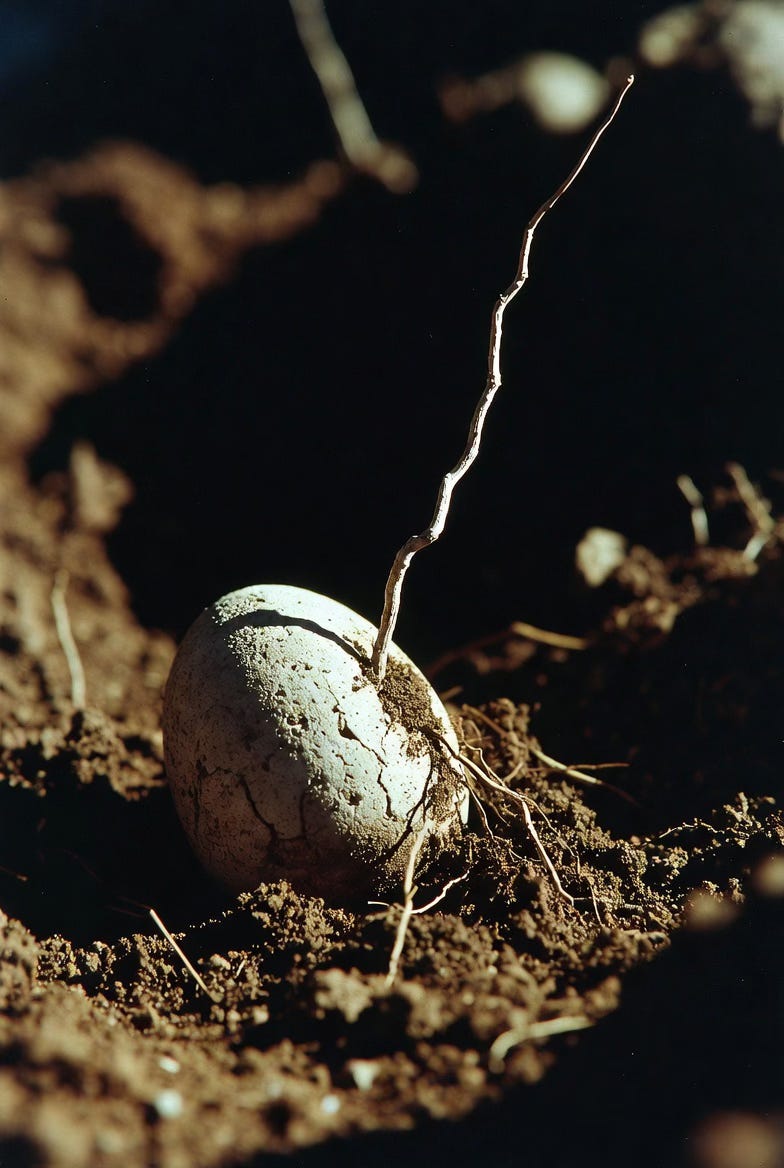
Easter presents itself as a singular event. A morning. A stone rolled away. A body that refuses its own conclusion. Yet beneath this theological clarity, something older breathes… slower, less concerned with doctrine, entirely uninterested in being named.
The pattern predates every tradition that has claimed it.
At its core, Easter is anchored in the Christian narrative of the resurrection of Jesus, the Christ: the passage from death into life that stands as both historical claim and metaphysical assertion. But the timing of Easter betrays a more complex inheritance. It is not fixed to a calendar date. It is determined by the first full moon after the spring equinox; a calculation that places it firmly within a much older system of seasonal reckoning, one that predates Christianity by millennia and was concerned less with salvation than with survival.
The equinox is a hinge in the year, a moment when light and darkness hold equal weight before light begins its ascent.
Across cultures, this threshold has been marked by rituals of renewal, fertility, and return. The land, after a season of apparent death, begins to stir. Seeds reveal themselves as latent life. Something sealed opens. The resurrection, in this broader sense, is not an anomaly but a recurrence… something the world does every year, and something human beings have felt compelled to ritualise for as long as they have watched winters end.
Christianity did not invent this pattern. It inherited it, named it, and gave it a face.
The Paschal celebration itself is rooted in the Jewish Passover: a commemoration of liberation, of passage through a threshold where one condition ends and another begins. When the Christian resurrection narrative aligns with Passover, it inherits not only the timing but the symbolic architecture; death as prelude, not conclusion; departure as the precondition for arrival.
But the inheritance goes deeper, and here is where it becomes genuinely strange.
Centuries before the Christian era, the ancient Near East was already saturated with dying-and-rising gods.
Tammuz, the Sumerian shepherd-deity, descended into the underworld and was mourned with annual lamentations.
Adonis; beloved of Aphrodite, killed by a boar… was wept over each spring and ritually restored.
Osiris was dismembered, scattered across the earth, and reassembled by Isis before his resurrection as lord of the dead.
These are not superficial parallels. They are structurally identical to the narrative Christianity would later consider unique: a god dies, the world mourns, the god returns, the world is renewed.
Early Christians knew this, and they were troubled by it.
Justin Martyr and Tertullian, writing in the second century, both confronted the obvious resemblance between the resurrection of Christ and the mystery cults surrounding these earlier figures. Their explanation was extraordinary: they called it diabolica imitatio: diabolical imitation.
The devil, they argued, had counterfeited the resurrection in advance, planting false versions of the story in pagan religion to confuse believers when the real event occurred. The logic is remarkable in what it reveals: even the most ardent defenders of Christianity’s uniqueness could not deny the resemblance. They simply relocated its cause.
What this suggests is not that any single version is derivative of another, but that the pattern itself is older than any tradition that has carried it. The dying and rising of a sacred figure, timed to the return of spring, speaks to something that human beings have repeatedly needed to say… and have said, in different languages, across thousands of years.
This need is not difficult to understand. It offers a structure for enduring loss. It proposes that what withdraws is not gone. That absence is not always terminus. That what appears to conclude may be, in fact, in transit.
Hermetic tradition would recognise this immediately. The principle of correspondence: as above, so below, holds that patterns repeat across different scales of reality. The resurrection of a god, the return of spring, the renewal of the inner life after a season of contraction: these are not separate phenomena but variations of the same underlying movement. The scale changes. The language changes. The structure persists.
There are, of course, more modern accretions. The commercial Easter… chocolate eggs, pastel aesthetics, orchestrated innocence, often obscures the older strata. Yet even here, the underlying motifs refuse to disappear entirely. The egg remains: a closed mystery that will eventually open into articulation. Something sealed, something that does not yet resemble what it will become.
The Dionysian thread is worth noting here. The ritual tearing and consuming of the god: sparagmos, omophagia, is the mythic ancestor of eucharistic logic.
Eating the god is not a Christian invention. It is a very ancient way of saying that the sacred can be taken inside, that the boundary between the worshipper and the worshipped is permeable. The Last Supper does not emerge from nowhere. It arrives already charged with thousands of years of meaning.
The Hermetic tradition offers the most precise language for what all these parallel myths are actually describing. The principle of correspondence: as above, so below; as without, so within, holds that the same pattern manifests simultaneously at every scale of reality. What the earth does in winter and spring, the cosmos does across vast cycles, and the individual human being does across a lifetime, and sometimes within a single year, or a single night. These are not analogies. They are the same movement, expressed at different magnitudes.
To understand one is to understand all of them.
This is why the mystery traditions: Eleusinian, Orphic, Mithraic, Hermetic… were not primarily concerned with mythology as narrative.
The myths were maps. The descent of Persephone, the dismemberment of Osiris, the death of Adonis: these were not stories told about distant gods. They were templates for what the initiate was expected to actually undergo.
The ritual was designed to produce a genuine experience of dissolution: the temporary death of the self as it had been constituted, precisely because nothing new can be born into a space already fully occupied. The old form must vacate first.
What dies in these rites is never the body. It is the self that has calcified around an identity that no longer fits; the accumulated armour of who we believed we were, or who we were told to be, or who we became in order to survive conditions that no longer exist. The initiand who descends does not come back the same. They come back reduced to what is essential, and therefore, paradoxically, enlarged.
This is the resurrection the mystery traditions were pointing at long before any specific theology claimed it.
Not a miracle that happens once, to one figure, in one tomb.
A law. Something the soul is required to pass through, more than once, in order to remain alive in any meaningful sense.
Easter, understood this way, is not a commemoration of something that happened to someone else. It is an invitation… or a demand, directed at whoever is standing before it.
What in you has already died but not yet been buried?
What are you still carrying that was finished long ago, out of habit, or fear, or because you were not sure you could survive putting it down?
The stone at the entrance of the tomb is not always rolled away by angels. Sometimes it requires the full weight of a willingness to let what is dead be dead… so that what is trying to be born has somewhere to arrive.
One answer is that the pattern corresponds to something actually experienced. Not metaphorically: actually.
Winters end. Seeds that appeared dead are not. Things sealed open.
People who believed they were finished discover they are not.
The myth persists because the world keeps demonstrating it, and the psyche keeps living it.
Easter, then, is not primarily a celebration. It is a wager that human beings have been placing, in various forms, for as long as they have watched the year turn.
A wager that what withdraws is not gone.
That what is sealed is not finished.
That beneath the surface of what appears concluded, something continues its quiet, invisible work.
The stone rolls away. It has always rolled away.
What changes is only the name of the one standing outside the tomb.
You write like a historical epic from places unknown and known, it flows back and forward in front of my eyes for you, your world. I love your reading.so much passion in word and sentence; paragraph to page. On your stage of collage, pieces of you in all you do. Your work like runs for me to catch up, I catch you,rolling on a blanket when you are done.
I love this. Myths truly are maps—they carry hidden truths within them. While writing Lost & Found and The Full Life, I immersed myself in many myths, including those of Aphrodite and Adonis. And I sense, deeply, that much more is yet to come, as these ancient stories continue to call me to retell them. 🙏