
Permission to Exist
Who gave you the right?

No one should need permission to exist.
Independent art survives because someone chooses to help it to exist.
If this work speaks to you, consider becoming a paid subscriber.
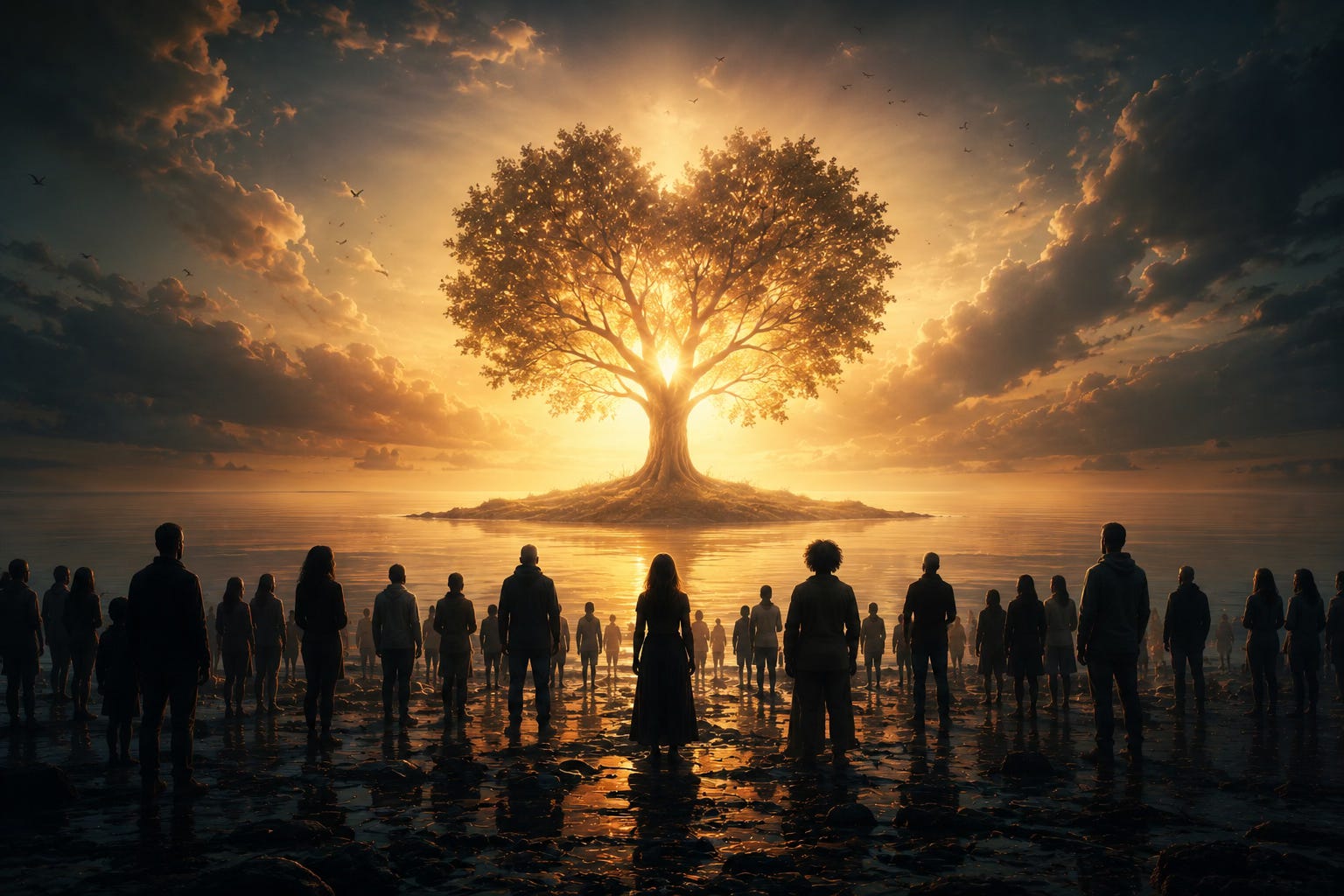
Every society claims to value human beings.
Yet every society spends an astonishing amount of time deciding which human beings are allowed to be fully human.
This is not a controversial observation. It is barely even an observation. It is just what happens, generation after generation, in every country, in every culture, in every family.
Never before have we spoken so much about inclusion, equality, diversity, mental health, compassion, and human rights. Our public vocabulary has become increasingly moral. Every institution has a statement. Every corporation has a campaign. Every politician has the appropriate language. We have learned to display the right values with remarkable fluency.
And yet, much of it remains beautifully photogenic.
The language changes faster than the structures. We become experts at appearing humane while preserving the habits, incentives, and institutions that quietly decide whose suffering matters, whose voice carries authority, whose failures deserve understanding, and whose existence must still be justified.
We say we believe in human dignity. Yet we spend enormous institutional, social, and personal energy managing the parts of people that make us uncomfortable.
Not by excluding them completely. That is rarely necessary anymore. By making acceptance conditional upon becoming easier to accommodate.
Some people learn to become smaller almost without noticing it. Others learn to become quieter. Some edit themselves before speaking, before loving, before creating, before simply walking into a room.
The child who learns to laugh differently so the others will stop watching. The woman who takes up less space at the table… literally, elbows in, shoulders curved, and eventually forgets she was ever any other size. The man who discovers, once, that his tears make people uncomfortable and never cries in public again. The person who learns to enter every room already asking forgiveness for existing.
Others spend years apologizing for qualities that were never defects, only differences that happened to make somebody else uncomfortable.
The circumstances vary. The pressures change. The stories could not be more different… yet, beneath them all, lies the same instruction repeated so often that it eventually sounds like common sense:
Become less, and the world will become easier to live in.
None os them did anything wrong. They were simply born as themselves.
And somehow that required management.
This is what I keep returning to. Sometimes it is cruelty. Sometimes it is fear. Sometimes it is simply habit. But what stays with me is how ordinary the arrangement has become.
Nobody asks permission to be born.
Yet millions spend their lives asking permission to exist.
We did not choose our body, our mind, our temperament, our desires, our origins, or our strangeness. We simply arrived, and somewhere between arriving and growing up, we inherited a set of instructions. Never written down. Yet perfectly legible.
Be less.
Take up less space.
Hide that part.
Tone it down.
Make yourself easier to understand.
Make yourself easier to tolerate.
Most of us complied because belonging has always seemed safer than authenticity, and because the fear of abandonment often proves stronger than the desire to remain entirely ourselves.
So we became smaller.
We became manageable.
We became versions of ourselves that caused less friction.
We called it growing up.
Or maturity.
Or learning how the world works.
Long before identity becomes a political category, it begins as something much simpler:
A child discovering which parts of themselves are welcome.
An adult discovering which parts are not.
It is about the right to breathe without apologizing. To exist without authorization. To BE without asking permission from people who never possessed the authority to grant it.
And at some point… I do not know exactly when it happens, but it happens…something in a person grows tired of reducing itself.
Something very quiet.
Very old.
Very stubborn.
It says:
No.
Not as anger.
Not as a manifesto.
Simply as a fact:
Who taught the child,
to hide their voice?
Who taught the heart,
to fear its choice?
Who taught the strange,
to stand apart?
Who taught the living,
to divide their hearts?
Who taught us silence?
Who taught us shame?
Who taught us all,
to shrink our names?
Who drew the line?
Who built the wall?
Who stood above us,
judging all?
Who held the gate,
and claimed the right,
to ration human light?
Who gave you the right?
Who gave you the right?
To measure a soul.
To ration the light.
To say who belongs.
And who should fall.
Who gave you the right?
Nobody at all.
A million voices,
cut in two.
A million lives,
made less than true.
A million people,
learning fear.
A million selves,
that disappeared.
Be less.
Be quiet.
Be smaller.
Behave.
Be grateful
for the space we gave.
Who gave you the right?
Who gave you the right?
To measure a soul.
To ration the light.
To say who belongs.
And who should fall.
Who gave you the right?
Nobody at all.
Nobody asked permission
to be born.
Nobody chose
the shape they wore.
Nobody arrived
asking to be approved.
Nobody arrived
asking to be removed.
And still we learned
to disappear.
And still we learned
to edit fear.
And still we learned
to bow our heads…
and call it life instead.
Who gave you the right?
Who gave you the right?
To measure a soul
To ration the light
To say who belongs
And who should fall
Who gave you the right?
Nobody at all.
I was here
I am here
I will be here
I was here
I am here
I will be here.
We were here
We are here
We will be here
We were here
We are here
We will be here.
No.
No.
No.
We will be here…
If this essay, this song, or this question stays with you after you leave, consider becoming a paid subscriber.
Your support allows me to keep writing, composing, and creating work that refuses easy answers and keeps asking the questions that matter.
Sara this resonates deeply. Thank you for your brilliant writing, advice and verse. I am deeply grateful.
Such a brilliance Sara 🫶