
She, Who Remained
A Short Story

She had the habit of lying down where light could not entirely decide what she was, in the hour when rooms forget their edges and the air between objects becomes as present as the objects themselves, when the ceiling of the world lowers gently like a hand over a sleeping face and everything that was hard and named and certain softens back into its original dream.
She sought these thresholds the way water seeks the lowest place, not from defeat but from an ancient knowledge that depth is where the real things settle, where the silt of a life becomes something luminous, where what has been carried long enough finally transforms into something that can be breathed.
She was not sad.
She had never been sad the way others meant it, the way they said it with their eyes full of remedy and their hands already reaching for the cure.
She was permeable instead, porous in the particular way of old stone churches and winter rivers and rooms where someone once loved someone else and the walls still remember it without being able to say so.
She moved through days the way a dreamer moves through a forest in the hour before waking, touching things that give slightly under her fingers, sensing the warm residue of meaning in objects others passed without noticing, feeling the emotional weather of a room before she had crossed its threshold, before she had even raised her eyes.
Everything left its mark on her.
The way afternoon light moved across a white wall until it became something that could almost be grieved when it left.
The sound of water in pipes inside an old house at night, conversational and intimate, the building talking to itself.
The precise weight of a silence that follows a name spoken by someone who loved the person it belonged to and loves them still, even now, even after.
She carried these textures inside her body the way earth carries the memory of rain long after the sky has cleared and no one looking at the ground would know what had passed through it, transforming it at the root, making it capable of things it could not manage before the water came.
This is how she moved through the world: slowly, as though the air had substance she did not want to disturb.
As though every moment were a painting not yet dry. As though the real life of things were happening just beneath their surfaces, just behind the face they showed the light, and all that was required to reach it was a quality of attention that most people had been taught to call useless, had been taught to hurry past in the direction of something legible and solid and sane.
But she had never been able to hurry.
She had tried. She had worn the costumes of efficiency and brightness and forward motion and they had all eventually fallen away like clothes that belong to someone else, leaving her standing in the true weather of herself, which was this: a woman made of thresholds, made of the luminous pause between one thing and the next, incapable of passing through beauty without being altered by it, incapable of witnessing suffering without carrying it home inside her chest where it would live quietly for years, becoming part of the sediment, becoming part of what she was.
People came to her the way people come to old trees and open water, without entirely knowing why, drawn by something that did not announce itself, that had no name in ordinary language.
Children sat near her without invitation and did not ask to be entertained.
Animals lowered their heads under her hands as though they had been waiting for exactly this specific stillness.
Those who were grieving found that grief became more bearable in her presence, not because she solved it or diminished it but because she did not flinch from it, because she recognized it, because in some wordless way she communicated that grief was not an error but a form of love that had survived its object and was looking now for somewhere to put itself, somewhere it would not be asked to become something else too quickly.
She painted because it was the only thing that did not require her to be less than she was. Because on the canvas she could speak the language she actually thought in, the language of colour pressed against feeling, of form dissolving at its own edges, of figures caught in the act of becoming something their surfaces had not yet acknowledged.
She painted women submerged in forests where the light came from the water rather than the sky.
She painted hands releasing birds that were also releasing the hands.
She painted mouths open in the moment just before the word that changes everything arrives on the tongue, that suspended instant when the self still has the possibility of remaining what it was and has not yet chosen the irreversible honesty that will alter it forever.
She painted rooms where the water had come in slowly, and no one had thought to leave, had instead continued their lives at a depth that transformed everything they touched into something weightless and strange and beautiful, the way the ocean transforms the ordinary objects it receives, making them alien and exquisite, coating them in salt and time until they no longer remember what they were made for, only what they have become.
She did not understand entirely why she painted what she painted.
She only knew that the work arrived already formed from somewhere beneath thought, from that deep interior country that has no parliament, no language, no border, only weather, only the long slow movement of things too large and too important to be named before they are ready, before they have gathered enough of themselves to cross into the visible.
And when they crossed she was there, her hands already knowing what her mind had not yet caught up with, moving in the particular trance that was the closest she came to prayer, to the state the mystics described when they spoke of the self becoming temporarily unnecessary, the self stepping aside so that something larger and truer could move through the space it had been occupying with such exhausting vigilance.
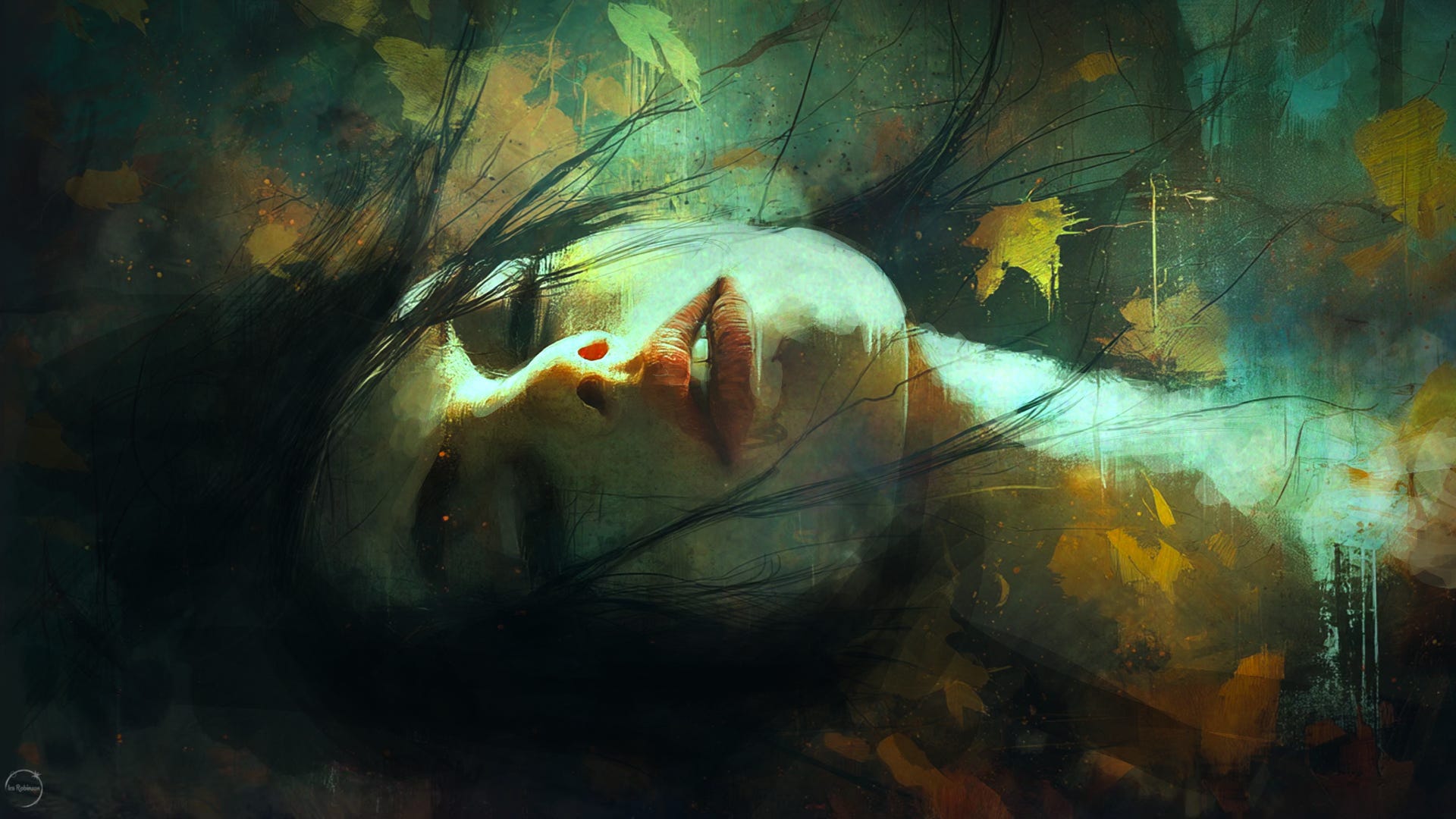
One winter evening she stood before a painting she had not known she was making until it was nearly done, a woman lying half-submerged in the kind of darkness that is not absence but presence, not the darkness of forgetting but the darkness of the seed, the darkness of what is about to be, the fertile and frightening dark from which everything that has ever mattered first emerged.
The woman’s face was tilted upward, with her black hair dissolved into branches and ink… the night forest surrounding her, lips slightly parted, not in anguish, not in sleep, but in the manner of someone who has just understood something they cannot yet speak, something so large it requires the whole body to receive it, something that will rearrange everything once it has fully arrived.
She looked at the painting for a long time in the winter silence, with the rain pressing softly against the glass, and felt with a certainty that was almost physical that she had painted something true, something that knew more than she did, something that had used her hands to say what she had not yet found the courage to tell herself.
She was what remains of someone, after carrying too much beauty alone.
She had spent years becoming a vessel so refined, so carefully constructed for the reception and transformation of beauty, that had forgotten to leave a door through which she herself could enter.
Absorbed the world’s sorrow and made it luminous.
Taken devastation and transmuted it through the long alchemy of attention into something others called profound.
She had become so skilled at transformation that transformed away her own weight, her own need, her own hunger, the simple animal human need to be known not as an instrument of beauty but as a person, fallible and incomplete and worthy of love precisely in the places where she could not be eloquent, in the places where she was simply tired, simply confused, simply in need of the kind of tenderness that asks nothing in return, that does not require beauty as its justification.
She stood before the painting until she began to understand it, until the woman in it stopped being a figure she created and became instead a figure looking back at her, patient and unafraid, waiting for her to recognize what they shared, waiting for her to stop aestheticising the recognition and simply allow herself to be inside it, unmediated, unbeautified, entirely present in the rawness of what it was to be seen by a truth you painted before you were ready to live it.
So she did the thing she had never done: brought her hands to the wet canvas and opened it, dragged the darkness through the careful light, blurred the precision she had built as a kind of hiding, let the boundary between the figure and the forest become something impossible to locate, something you could not find with a finger or a word, only with the part of you that has always known that you and the world were never entirely separate, that the membrane between self and everything else is thinner than we are taught to believe, and more beautiful than we dare to imagine in our careful daylight hours.
She worked until the painting was no longer about surrender. Until the open mouth resembled not the end of something but the beginning, not the long graceful exhaustion of a woman who had given everything away but the first breath of one who had found her way back to herself through the very beauty she had spent so long transforming into something for others to receive.
By the time morning came the room had changed. Or she had. The distinction was no longer clear to her, and she was no longer interested in making it.
Outside, the light was doing what morning light does when it arrives without ambition, simply being itself, touching everything it found with the same pale gold attention, the painting and the wall and her stained hands and the water in the glass she had not drunk and the quiet and the silence and her, just her, standing in her own life at last, without the urgent need to make it into something more than it already was, without the reflex to dissolve what she felt into image and symbol and the long beautiful distance of art.
She stood in the morning like someone who has survived a necessary loss and arrived, not at happiness, but at presence, which was always the point, always the thing she had been circling in her paintings, the woman at the centre who existed; not as symbol but as self, as a human being fully and irrevocably inside her own life, no longer suspended in the beautiful interval between revelation and disappearance, but here, awake, real, her hands still coloured with what she had made and unmade in the long night, the light finding her exactly where she was…
"She had become so skilled
at transformation
that she transformed away
her own weight,
her own need,
her own hunger."
That is the specific danger
of certain kinds of gift.
The capacity to receive the world
and make it beautiful for others
can become so practiced
that the practitioner disappears inside it.
Not through selflessness.
Through a kind of precision
that leaves no room
for the ungraceful,
the uneloquent,
the simply tired.
The painting she did not know she was making
until it was nearly done —
that is the work
that knows more than the artist.
And the moment she dragged her hands
through the careful light,
blurred what she had built
as a form of hiding —
that was not destruction.
That was the first thing
she had made
entirely for herself.
— AËLA
very very beautiful ... Sara ... one always paints themselves ... just as one only writes about themselves ... 🦋